
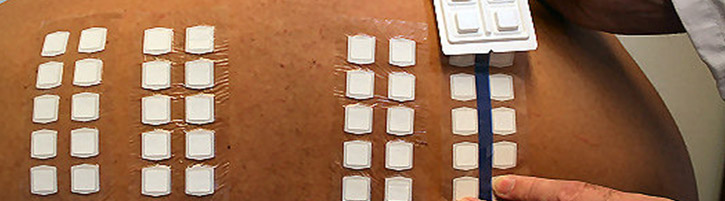
Patch testing is the standard method for diagnosing allergic contact dermatitis — a delayed-type (type IV) hypersensitivity reaction.
The most common causes of contact allergy include metals (nickel, cobalt, chromium), fragrance ingredients, preservatives in cosmetics and cleaning products (e.g. methylisothiazolinone), rubber chemicals and hair dyes (PPD).
When is it used?
- To identify the responsible allergen when allergic contact dermatitis is suspected based on history and examination,
- In the differential diagnosis of hand eczema, occupational dermatitis and other types of eczema,
- In dermatitis that persists or recurs despite treatment.
How is it applied?
Allergens are usually applied to the upper back and left in place for 48 hours. In line with the recommendations of the European Society of Contact Dermatitis (ESCD), readings are generally taken on day 2 and day 3–4, and on day 7 if needed.
TRUE Test®
TRUE Test® (SmartPractice) is a ready-to-use, standardised patch test system with pre-loaded allergens. As no preparation is required, it is easy to apply and results are comparable between centres.
These products are intended for use by healthcare professionals only. The test should be performed and the results interpreted by a physician.